
Article: Flowers for Asian Holidays: Lunar New Year, Tet and Diwali
Flowers for Asian Holidays: Lunar New Year, Tet and Diwali
Quick Answer
In Chinese tradition, Lunar New Year flowers are chosen for luck and prosperity: orchids, peonies, plum and peach blossom, kumquat trees and red or gold arrangements, while white flowers are traditionally avoided because of their link to mourning. Tet, the Vietnamese new year, centers on yellow mai blossom in the south and pink peach blossom in the north. In Hindu practice, Diwali flowers include marigold garlands, lotus offerings and petals for rangoli. The meaning of Asian flowers changes from one culture to the next, and these customs belong to specific families, so treat this guide as a description, not a rulebook, and ask the host when you are unsure.

Lunar New Year Flowers: What Is Traditional and What Is a Florist's Choice
Lunar New Year begins with a new moon in late January or February, according to Britannica. It is celebrated in several cultures, including Chinese, Vietnamese and Korean ones. The customs below are the ones most people mean by flowers for Chinese New Year. They are Chinese, mostly Cantonese and southern, and should not be assumed for other communities.
The South China Morning Post describes Hong Kong households decorating with plants and flowers for the festival and the flower fairs that open beforehand, and the Guangzhou government tourism page describes a peach blossom branch as a New Year purchase in that city. Cornell Botanic Gardens adds that plants are also given as gifts to convey happiness and good fortune. A Lunar New Year flower arrangement for a host is a florist's natural extension of that custom.
Lunar New Year flowers means:
- A Chinese New Year flower is usually a plant or bloom bought for the home before the festival, each tied to a wish in Chinese tradition
- Luck, wealth, longevity and a fresh start, usually carried by color and wordplay
- A tradition of displaying flowers at home during the festival, with details that vary by region and family
Best for:
- Anyone decorating a home for the New Year in the Chinese tradition
- Hosts and families who want flowers for Lunar New Year that fit the tradition
- Senders choosing Chinese New Year flowers who want to avoid a misstep
Here is what each flower is said to mean in Chinese tradition:
- Orchids. In Chinese tradition the orchid stands for refinement and abundance, according to the UBC Botanical Garden, and for nobility, according to Wellfield Gardens. It is one of the Four Gentlemen of Chinese painting, together with plum, bamboo and chrysanthemum. See our orchid flower meaning guide and orchids.
- Peonies. The peony stands for wealth and rank, according to Smithsonian Libraries. Cornell Botanic Gardens notes that red peonies are popular at the festival. Peonies are a spring bloom, so availability in winter varies. Read about peony flower meaning or browse peonies.
- Plum blossom. It blooms in winter and stands for perseverance and the return of spring, according to the Chinese Online Museum and The Met.
- Peach blossom. In Guangzhou a peach blossom branch or tree is bought for New Year, and it is one of the essential flowers at the city's flower fair. Folk belief links it to romance and success, according to the Guangzhou government tourism page.
- Kumquat and tangerine trees. Because in Cantonese the words for them sound like gold and luck, families buy these trees at New Year, according to the South China Morning Post, and Professor David Jordan of UC San Diego explains the gold pun.
- Pussy willow. Its Chinese name means silver willow, and in tradition the silvery catkins link it to silver and prosperity. Cornell Botanic Gardens and UBC read the buds as growth and coming prosperity.
- Narcissus. Called water fairy, it is grown in water and pebbles and is linked to good fortune and prosperity, according to Cornell Botanic Gardens.
-
Chrysanthemums. They are tied to longevity, and also strongly to funerals in China, which leads to the next section.
Colors and What to Avoid at Lunar New Year
Red is the dominant color of the New Year, said to scare away the legendary monster Nian, according to Britannica, and Wikipedia links red with joy and luck. Gold suggests wealth.
Lunar New Year colors means:
- Red for joy and luck, gold for wealth
- In Chinese tradition, a warm palette with white and mourning colors avoided
Best for:
- Choosing an arrangement color for a New Year celebration
- Checking a gift before you send it
- Planning flowers for a household that keeps Chinese New Year customs
A few things are avoided, and each is a belief, so please read them as such:
- White and black. Wikipedia's article on Chinese New Year notes that white and black are avoided as gifts because of their link to funerals. An all-white arrangement is the clearest mistake. Our guide to funeral flower etiquette explains how white flowers are used in mourning.
- White chrysanthemums. Legacy.com describes white and yellow chrysanthemums as traditional funeral flowers in China, and Chinese Showcase advises never giving white chrysanthemums for celebrations. UBC and Cornell, however, describe yellow chrysanthemums as lucky and a gift for elders, so accounts differ and it would be wrong to call every chrysanthemum lucky or banned. If you want a chrysanthemum, ask the family or choose a clearly festive color.
- Four of anything. Because the Chinese word for four sounds like the word for death, four of anything is avoided, according to Chinese Showcase, which suggests six, eight or nine instead.

Tet Flowers: The Vietnamese New Year
Tet is the Vietnamese Lunar New Year, and flowers are central to it. VietnamPlus describes families buying flowers and plants to decorate their houses, VOV describes flower markets that open across Ho Chi Minh City ahead of the holiday, and Vietnam News describes the Binh Dong Wharf flower fair there.
Tet flowers means:
- In Vietnamese tradition, blossoms and trees displayed at home to welcome the new year and spring
- A regional pair: yellow mai in the south, pink peach blossom in the north
- Wishes for luck, wealth and success
Best for:
- Vietnamese families and anyone welcoming a Tet host
- Choosing a regional touch if you know where the family comes from
- Senders choosing Tet flowers for a family visit
In southern Vietnam families display hoa mai, the yellow blossom of Ochna integerrima, which VietnamPlus describes as a symbol of Tet. It stands for luck, wealth and success. In northern Vietnam the pink peach blossom, hoa dao, is the traditional Tet flower, and VietnamPlus says folk belief holds that it wards off evil spirits. Kumquat trees heavy with fruit are displayed as a sign of prosperity, as VTV and VietnamPlus report, and chrysanthemum is read as longevity, according to Vietnam News.
Seollal in Brief: The Korean New Year
Seollal flowers means:
- In Korean tradition, a holiday centered on ritual and food, so flowers are a modern, optional gesture
- Food gift sets and family rites at the center of the day
Best for:
- Visitors to a Korean family at the New Year
- Readers who want the cultural background
Seollal, the Korean Lunar New Year, is built around the ancestral rite called charye, the deep bow to elders called sebae, rice cake soup called tteokguk, and hanbok, traditional clothing, according to Korea.net and the Korea Times.
The customs above do not center on flowers. If you want to bring flowers to a Korean family, treat it as a modern, optional gesture. Our flowers in a vase arrive ready to place on a table.
Diwali Flowers: Marigolds, Garlands and Gifts
Diwali, the festival of lights, is observed by Hindus, Sikhs, Jains and some Buddhists, as Kew Gardens notes. It follows the lunisolar calendar and falls between mid-October and mid-November. The flower customs below come mainly from Hindu practice.
Diwali flowers means:
- In Hindu practice, marigold garlands, lotus offerings and petals used for decoration and worship
- A bright, fresh, long-lasting look for a home
- Welcome decor for a host, with sweets as the more traditional gift
Best for:
- Hosts decorating for Diwali
- Guests bringing flowers to a celebration
- Anyone planning a Diwali flower decoration at home
Marigold is among the flowers the Society of American Florists lists for Diwali decorations, often strung together and hung around the house, and Kew Gardens associates the marigold with good fortune. Lakshmi, the goddess of prosperity and wealth, is shown on or holding a lotus, and many Hindus worship her on Diwali night, offering the lotus as her favored flower, as Religion Unplugged and Kew Gardens describe. Rangoli, floor designs drawn at the doorway with rice flour, is made to welcome good fortune, according to the Asian Art Museum in San Francisco, and a CNN Underscored contributor describes rangoli made with flowers and diyas. For a decoration at home, a marigold garland or a bowl of petals follows that tradition. See our guide to marigold flower meaning.
The Society of American Florists names roses among the Diwali flowers commonly used in the United States, and Kew Gardens notes that jasmine is often used for Diwali and in Hindu ceremonies. Browse roses for a rich red option.
On gifts, CNN Underscored quotes a jeweler who lists gold, dried fruit and sweets as traditional Diwali gifts, and notes that diyas are commonly gifted. Flowers are a welcome addition, especially as decor for a host, but they are not the traditional Diwali gifts themselves. The Society of American Florists notes that some traditional Indian Diwali flowers can be hard to find in the United States, and lists marigolds, roses, carnations and chrysanthemums among the flowers commonly used here. It also advises that arrangements last at least a week, because wilted flowers are considered inauspicious. No single rule about flowers to avoid applies to every home, and offering customs vary by deity and household, so ask the host if you are unsure.

Mid-Autumn Festival Flowers in Brief
The Mid-Autumn Festival falls on the 15th day of the eighth lunar month, when the moon is fullest, and centers on family reunion, mooncakes and lanterns. The Shanghai government's English site and the Singapore National Library Board describe it, and Vietnam celebrates it as Tet Trung Thu.
Mid-Autumn Festival flowers means:
- Osmanthus, the flower of the season, linked to the moon in legend
- A modern gesture, since mooncakes and fruit are the traditional gifts
- A festival centered on family reunion rather than flowers
Best for:
- Hosts of a reunion dinner
- Senders pairing a mooncake box with something fresh
- Readers who want the cultural background
Osmanthus (gui hua) blooms in autumn around the festival and is linked to it through osmanthus wine, sweets and the legend of Wu Gang, who is condemned to fell an osmanthus tree on the moon, according to the Shanghai government site, and the Singapore National Library Board notes that osmanthus blooms during the festival. Wikipedia's Wu Gang article adds that the tree is often rendered as cassia. Mooncakes and fruit are the signature gifts, as China Highlights and the Singapore National Library Board note, so flowers are not the traditional gift, and a bouquet is a modern gesture if you add one to a mooncake box.
How to Choose Flowers for a Family Celebration or a Gift
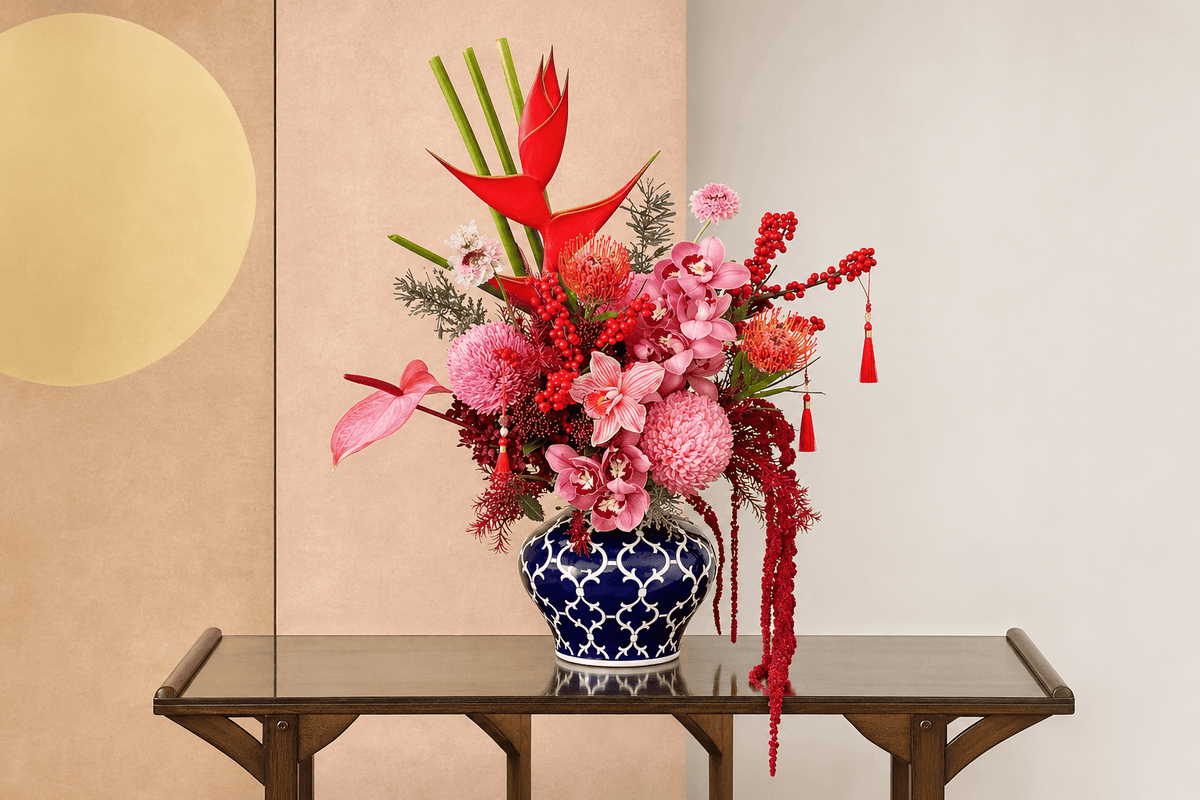
In Chinese and Vietnamese tradition flowers are displayed in the home, so the simplest gift is one that helps a host decorate. For Lunar New Year gifts, I would suggest an orchid arrangement or an arrangement in red and gold, both considerate choices, and the same logic applies to a Tet visit. For Diwali, think warm orange and yellow tones in a vase that lasts a week or more. For Mid-Autumn, I would keep it to a small arrangement beside a mooncake box. These are a florist's suggestions, not customs.
- Choose a clearly festive color and avoid an all-white arrangement for Lunar New Year.
- For Lunar New Year gift ideas beyond orchids, consider red peonies if they are available, since Cornell Botanic Gardens notes they are popular at the festival.
- Avoid arrangements of four stems.
- Send flowers in a vase so the host has nothing to prepare.
- Ask the family if you are unsure, since customs differ between regions and households.
At Casa Dei Fiori, arrangements can be customized by flower, color, height and container, so you can ask for a palette of red and gold without white.
Timing and Delivery in Los Angeles
Plan ahead of the celebration, and avoid choosing a day when you know the family will be away from home. Our studio is at 9895 S Santa Monica Blvd, Beverly Hills, and delivery covers the Westside, including Pico-Robertson and Westwood.
Frequently Asked Questions
What flowers are lucky for Lunar New Year?
In Chinese tradition, orchids, peonies, plum and peach blossom, kumquat and tangerine trees, narcissus and pussy willow are associated with luck and prosperity. These meanings come from folk tradition and wordplay, so they differ by region and family.
What flowers should I avoid for Lunar New Year?
White and black are avoided as gifts because of their link to mourning, and white chrysanthemums in particular. Four stems or four stalks are avoided because the word for four sounds like the word for death.
What are Tet flowers?
Yellow mai blossom is the symbol of southern Vietnam, and pink peach blossom is the traditional Tet flower in the north. Kumquat trees and chrysanthemums are also common.
Are flowers a Seollal tradition?
Seollal centers on the ancestral rite, the bow to elders and a shared meal, so flowers are an optional modern gesture.
What flowers are used for Diwali?
Marigold garlands, lotus offerings and flower petals for rangoli are the best documented, with roses and jasmine also popular. Sweets and dried fruit are the more traditional gifts.
Are flowers a traditional Mid-Autumn Festival gift?
Mooncakes and fruit are the traditional gifts. Osmanthus is the flower linked to the festival through legend, and a bouquet is a modern addition.
Can I send flowers for an Asian holiday in Los Angeles?
Yes. Casa Dei Fiori delivers across the Westside, including Pico-Robertson and Westwood, with same-day service in Beverly Hills, West Hollywood, Century City, Santa Monica, Hollywood, DTLA, Marina Del Rey, Pasadena and Burbank.
Order Holiday Flowers in Los Angeles
Customer Lina York called our flowers "premium quality and very fresh." Visit us at 9895 S Santa Monica Blvd, Beverly Hills, CA 90212, call (424) 303-2291, or browse our flowers in a vase to find a ready-to-gift arrangement for your celebration.

Leave a comment
This site is protected by hCaptcha and the hCaptcha Privacy Policy and Terms of Service apply.