
Flowers for Jewish Holidays
Quick Answer
Flowers are a welcome gift at many Jewish holidays, but two occasions have a widely documented flower custom: Shavuot, when synagogues and homes are decorated with flowers and greenery, and Shabbat, when many families put a bouquet on the table. For Rosh Hashanah, Passover and Hanukkah there is no single required flower, so white, spring or blue and white arrangements are a florist's convention, not a rule. Keep arrangements low enough for a crowded holiday table, send them in a vase so the host has nothing to prepare, and remember that customs differ from one family and community to the next.
Are There Jewish Flowers? What Is Custom and What Is Choice
People often search for Jewish flowers expecting a list, like a symbol for each holiday. Judaism does not assign one flower to each festival the way some florists' guides suggest. What exists is a mix of old customs, community habits and modern good taste, and it helps to know which is which before you order.
Jewish flowers means:
- Flowers chosen for a Jewish home, table or holiday, not a fixed botanical list
- A few documented customs (Shavuot greenery, Shabbat bouquets)
- Florist conventions such as white for the High Holidays or spring colors for Passover
Best for:
- Hosts who want to bring Jewish holiday flowers without making a mistake
- Guests invited to a holiday meal who want a thoughtful gift
- Anyone sending Jewish holiday gifts to family, colleagues or neighbors
A few ground rules hold across nearly every occasion. Choose an arrangement that sits low, because a holiday table is already full. Ask whether the home is observant if you are unsure, and when in doubt, skip anything that needs assembling or arranging on the day. A bouquet that arrives in a vase is the easiest Jewish holiday gift to receive, because the host only has to find a spot for it.

Rosh Hashanah Flowers: White, Low and Ready in a Vase
Rosh Hashanah is the Jewish New Year, and the greeting you will hear is shanah tovah, meaning "good year," or shanah tovah umetukah, "good and sweet year," as Chabad and My Jewish Learning both explain.
White is the color most florists reach for among Rosh Hashanah colors, and it has real background. Many synagogues dress the Ark and Torah scrolls in white covers for the High Holidays, and the Schechter Institute traces the custom of wearing white on the High Holidays to the Talmud Yerushalmi. Practice varies, though. In many communities, including Chabad, the kittel (a plain white robe) is worn on Yom Kippur rather than on Rosh Hashanah. So white flowers for Rosh Hashanah are a graceful, widely understood choice, not an obligation.
Rosh Hashanah flowers means:
- A hostess gift or table accent for the New Year meal
- A fresh, clean palette, most often white with soft green
- A wish for a sweet year, never a required symbol
Best for:
- Guests arriving at a Rosh Hashanah dinner
- Sending a Rosh Hashanah gift to family who live across town
- Colleagues and clients you want to greet at the New Year
If you are choosing flowers for Rosh Hashanah, three stems work especially well. White roses are classic and read as celebratory. Hydrangea gives a full, generous look in a small footprint. Orchids last for weeks, which suits a holiday when the host will be busy and tired by the end of the meal. Rosh Hashanah colors can also include warm gold accents, since honey and apples are on the table, but I would keep the base white and add a single touch of warmth rather than a full autumn palette.
For a Rosh Hashanah gift, a compact arrangement in a vase, white and green, with a short note wishing them a sweet year, says more than any particular bloom. For more on how color carries meaning, see our guide to flower colors.

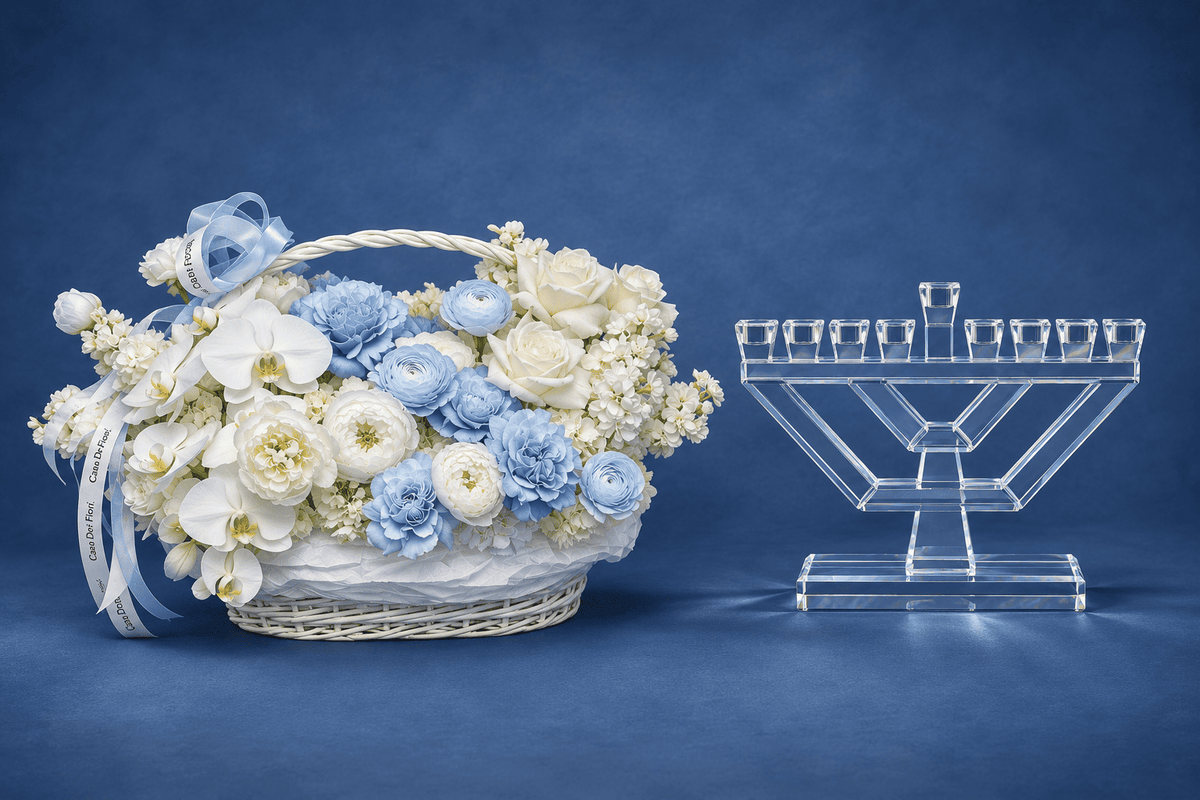
Large Crystal Clear Menorah
A luminous centerpiece for your Hanukkah celebrations. Crystal-clear elegance for a beautifully set holiday table.
SHOP THE MENORAH
Passover Flowers: Spring on a Crowded Table
Passover falls in spring in the United States, which is why seasonal flowers suit it. They are not part of the observance. Florist and gardening guides, including those from TJ Flowers NYC and Gardening Know How, describe Passover flowers as an optional seasonal touch, and there is no single emblematic flower and no official set of Passover colors.
What the Seder table (the Passover meal) does have is very little free space. The Seder plate, Elijah's cup, in many homes Miriam's cup, and bowls of salt water already occupy it, which is why the Jewish Journal steers hosts toward low arrangements that let guests see each other across the table. Passover centerpieces that tower over the plates get in the way of the meal.
Passover flowers means:
- A spring accent for the Seder and the festival meals
- A low arrangement that leaves room for the Seder plate and cups
- A seasonal gift, since Passover arrives with spring bloom
Best for:
- Seder hosts who want something fresh without crowding the table
- Guests bringing a gift to a family Seder
- Anyone sending Pesach flowers to relatives who are hosting
Spring stems are the natural choice for flowers for Passover tables. Tulips, ranunculus, hyacinth and peonies when in season all work, and soft pastels or white with green keep the table calm, and these are the Passover colors most florists suggest. For flower arrangements for Passover, I would pick a compact vase or a low bowl and keep scents mild, since strong fragrance competes with the food. Blue and white styling is a decorating choice, not a Passover custom.

A lovely detail for anyone who likes the textual side of the holiday: the Talmud (Berakhot 43b) records a blessing, Birkat Ha'ilanot, to be said on first seeing blossoming fruit trees in the month of Nisan, the month in which Passover falls, as the OU and Chabad both note. It is not a Passover observance.
Shavuot Flowers: The Holiday With a Flower Custom
Shavuot is the festival with the best-documented flower custom. It commemorates the giving of the Torah at Mount Sinai, and tradition holds that the mountain, normally barren, was miraculously covered in greenery at that moment. Aish notes that many synagogues are decorated with flowers on Shavuot, and Chabad describes decorating both synagogue and home with greenery and flowers.
Sources give several explanations for the custom. The Mishnah (Rosh Hashanah 1:2) names Shavuot as the day on which trees are judged, which the Jewish Encyclopedia and Chabad cite as a possible origin of decorating with greenery. Song of Songs 2:2 describes a rose among thorns, which the Midrash reads as the Jewish people, and Chabad lists that reading among its reasons for Shavuot flowers. The Maharil, a German rabbi of the late fourteenth and early fifteenth century, recorded the custom of spreading grass and fragrant flowers on the synagogue floor. Aish also notes that some Middle Eastern Jewish communities called the holiday the Festival of Roses.
It is not universal, however. The Vilna Gaon objected to the greenery custom because it resembled the practice of non-Jews, and some communities therefore do not decorate with greenery, as the Jewish Encyclopedia and Chabad explain. That is exactly the kind of difference that makes customs vary, and it is worth a quick question if you are sending to a very traditional household.

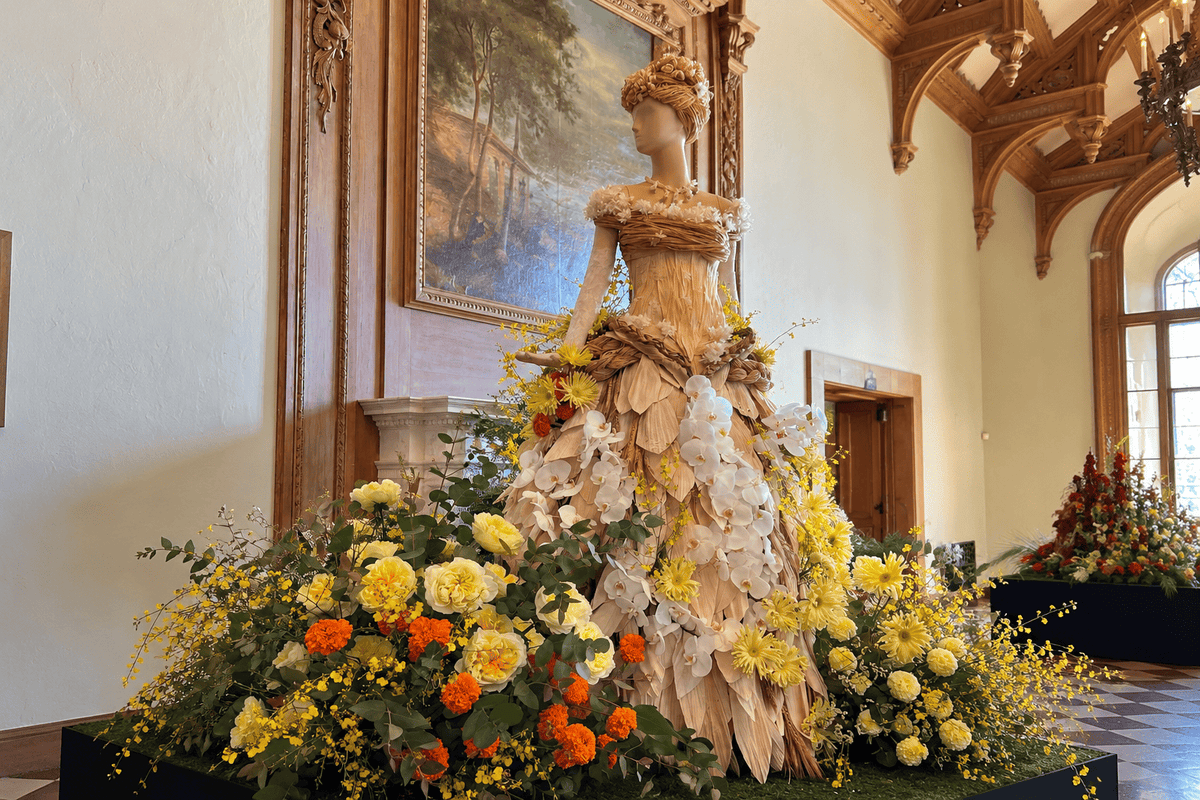
BOHO GODDESS
Abundant blooms, lush greenery, and a golden vase. Bring a fresh floral touch to your Shavuot table or send a thoughtful gift to your holiday host.
SHOP BOHO GODDESS
Shavuot flowers means:
- Greenery and blossoms that recall the tradition of Mount Sinai in bloom
- A decoration many households and synagogues use
- A gift that fits the holiday's theme of Sinai and the Torah
Best for:
- Hosts decorating the home before the festival
- Guests bringing flowers for Shavuot to a holiday meal
- Congregations and community events
For Shavuot decorations, think abundant and green. Garden roses, peonies, white lisianthus and leafy branches fill a vase generously, and a loose, full arrangement suits the theme better than a tight dome. If you are ordering Shavuot flowers for a home, a wide low vase of roses and greenery on the holiday table is the one I would suggest first. Roses are a natural fit, and the rose among thorns is one of the reasons Chabad gives for Shavuot flowers.
Hanukkah Flowers in Brief
Hanukkah has its own full guide on our blog, so here is only the short version. Flowers are a host gift at Hanukkah, not part of the observance, and the usual palette is blue and white, with white orchids, white roses, or blue hydrangea with silver foliage. For styling the table, hostess gifts and ordering, read our complete guide: Hanukkah Flowers: What to Send and How to Style Your Table. You can also browse our seasonal holiday collection.
Shabbat Flowers: The Weekly Custom
If Shavuot is the festival with a flower custom, Shabbat is the weekly one. Aish notes that many families place a bouquet on the Shabbat table, QC Temple's list of small things to do for Shabbat includes arranging fresh flowers, and a Forward essay describes arranging Shabbat flowers as a personal ritual. It is gentle, regular and entirely a matter of household habit.

Shabbat flowers means:
- A weekly bouquet on the Friday night table in many households
- A small ritual of preparing the home before candle lighting
- A gift that fits a host's weekly routine
Best for:
- Guests invited to Friday night dinner
- Families who like fresh flowers every week
- A simple, recurring gift for someone who hosts
Candles are lit on the eve of Shabbat, most commonly 18 minutes before sunset, according to Chabad, and some communities light earlier. The practical lesson for flowers for Shabbat is that the bouquet should already be in the house and in its vase before then. Keep it modest and lightly scented. You can browse our Shabbat flowers collection for ready-to-gift options.
Sukkot, Yom Kippur and Purim in Short
These three come up often enough to deserve a few lines.
Sukkot flowers. The four species of Sukkot are the palm (lulav), myrtle (hadas), willow (aravah) and citron (etrog), from Leviticus 23:40, and they are ritual objects with their own rules, not a place for a florist's bouquet. If you are sending Sukkot flowers as a gift, ask the host whether they would like it indoors or in the sukkah.
Yom Kippur flowers. Yom Kippur is a solemn fast day, and many communities wear white. A bouquet is best sent before the holiday as a gift to a host, or for the festive meal that breaks the fast.
Purim flowers. Purim's custom is mishloach manot, gifts of food or drink sent to friends, from Esther 9:22. According to Chabad, only food or drink counts, so flowers do not count as mishloach manot, but they can accompany one.
Sukkot, Yom Kippur and Purim flowers means:
- Occasional gifts, each tied to its own custom
- A bouquet that supports the holiday and does not replace a ritual item or a food gift
Best for:
- Hosts and friends you want to greet at these holidays
- Anyone unsure whether flowers fit, who can simply ask the host
A Note on Mourning
If your question is about flowers for a Jewish funeral or for a family sitting shiva, some Jewish families prefer no flowers, and customs differ between communities, so ask the family or the funeral home first. Our guide to funeral flower etiquette covers the details.
Timing and Delivery Around the Holidays
Holiday evenings are tight. Candles are lit at a set time, guests arrive soon after, and a host does not want to be signing for a delivery during preparations. A few habits make sending easier:
- Order well ahead of the holiday so the flowers arrive before the meal.
- Pick an arrangement in a vase so there is nothing for the host to arrange.
- Avoid scheduling delivery on Shabbat or a festival day itself.
- Keep the card short and warm. Shanah tovah, chag sameach (happy holiday) or Shabbat shalom (peaceful Sabbath) all work, according to the occasion.
- If you are unsure about the household's customs, ask the host.
At Casa Dei Fiori, arrangements can be customized by flower, color, height and container, so a request such as "low, white and green" can be passed to the studio.
Frequently Asked Questions
What flowers are appropriate for Jewish holidays?
Almost any fresh flowers are welcome. White roses, orchids and hydrangea are safe choices for Rosh Hashanah and Hanukkah, spring stems suit Passover, and roses and greenery suit Shavuot. The key is a low, vased arrangement.
Are there special Jewish holiday flowers?
Not in the sense of a required flower for each festival. Shavuot has the clearest custom, with flowers and greenery decorating homes and synagogues, and Shabbat has the widely kept habit of a bouquet on the table. Everything else is a seasonal or florist's choice.
What flowers are used for Rosh Hashanah?
There is no required flower. White is the most common color florists use, and it echoes the white covers and clothing some communities use at the High Holidays. Many people pick white roses, hydrangea or orchids.
Are flowers appropriate for Passover?
Yes, as a spring accent and a host gift. They are not part of the Seder, so keep them low and out of the way of the Seder plate and cups.
Why do people put flowers out on Shavuot?
Tradition holds that Mount Sinai bloomed when the Torah was given, and sources also link the custom to the judgment of trees and to the rose among thorns in Song of Songs. Not every community follows it, and the Vilna Gaon objected to the greenery custom.
Can I send flowers for Shabbat?
Yes. A bouquet in a vase that arrives before candle lighting is a warm gift for a host.
Can I send flowers for a Jewish holiday in Los Angeles?
Yes. Casa Dei Fiori delivers across the Westside, including Pico-Robertson and Westwood, with same-day service in Beverly Hills, West Hollywood, Century City, Santa Monica, Hollywood, DTLA, Marina Del Rey, Pasadena and Burbank.
Order Jewish Holiday Flowers in Los Angeles
Customer Lina York called our flowers "premium quality and very fresh." Visit us at 9895 S Santa Monica Blvd, Beverly Hills, CA 90212, call (424) 303-2291, or browse our flowers in a vase to find a ready-to-gift arrangement for your holiday.

Leave a comment
This site is protected by hCaptcha and the hCaptcha Privacy Policy and Terms of Service apply.